Orchid GAN
StyleGAN2-ADA fine-tuned on Cattleya, giving a navigable latent morphospace for orchid floral form. The starting point of the orchid programme.
OrchidGAN is a StyleGAN2-ADA model fine-tuned on a curated set of Cattleya images, from weights pretrained on a public flowers dataset. It was the first piece of the orchid programme, and it answered one question: whether orchid floral morphology is learnable from photographs at all.
It is. What the model returns is a latent space you can move around in, which the panels below do four ways — sampling seeds, interpolating between them, mixing style across resolutions, and laying the space out as a UMAP.
The model has no notion of which orchid it has drawn, which is what led to orchid-clip-v8.
Interactive sampler
Browse pre-generated OrchidGAN samples (seeds 0–499).

Latent interpolation
Smooth transitions between two seeds.
seed 18 → seed 42
Style mixing
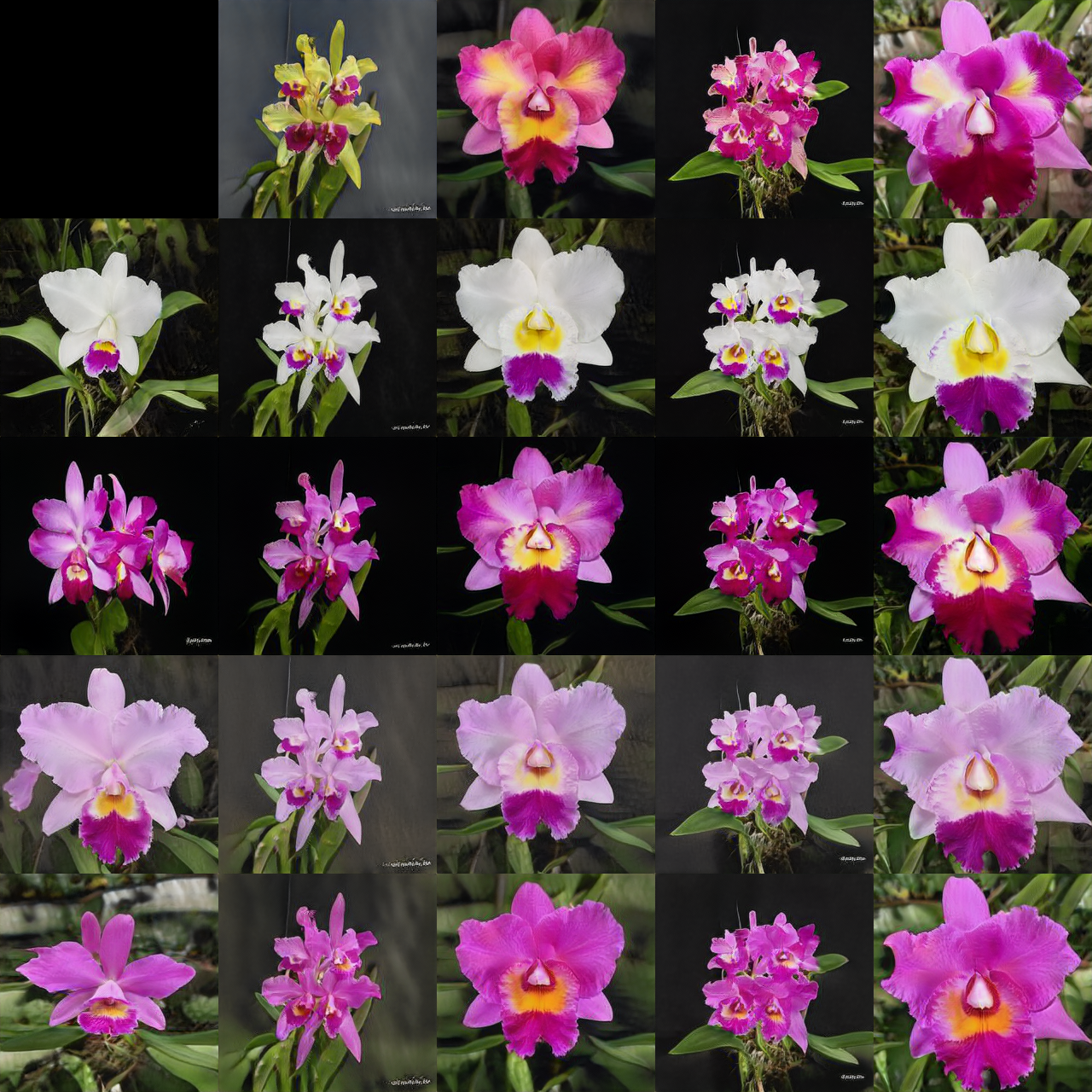
Rows control global structure; columns control fine details.
Morphospace (PCA)
Each point is a seed projected from latent z into 2D via PCA. Click a point to view its sample.

Morphospace (UMAP)
Each point is a seed projected from latent z into 2D via UMAP. Click a point to view its sample.
Latent Space Arithmetic
Discover interpretable directions in latent space. Adjust sliders to see how moving along these directions transforms the orchid.

How it works: We find direction vectors by averaging seeds with similar traits. Moving along these directions reveals what the model learned about flower morphology.
Attribution: This project builds on the StyleGAN2-ADA framework developed by NVIDIA. Initial model weights were pretrained on a publicly available flowers dataset and subsequently fine-tuned on a curated collection of Cattleya orchid images. Training images are not redistributed.